Search engines are increasingly becoming answer engines. AI-generated responses, sponsored placements, featured snippets, map packs, shopping units, forum results and other rich results now compete for the most valuable space on the search results page. In many cases, users can get an answer without clicking through to a website at all.
Research and industry reporting show that AI Overviews and zero-click behaviour are changing how users interact with search. Bain has reported that around 80% of consumers rely on zero-click results in at least 40% of their searches, reducing organic web traffic by an estimated 15% to 25%. A 2026 academic study also found that Google AI Overview exposure reduced daily traffic to matched English Wikipedia articles by approximately 15%.
For B2B companies, this creates a visibility problem.
If your static content is harder to find, harder to click and easier for AI systems to summarise without sending users to your site, you need more than traditional written content alone.
This is where video becomes increasingly important.
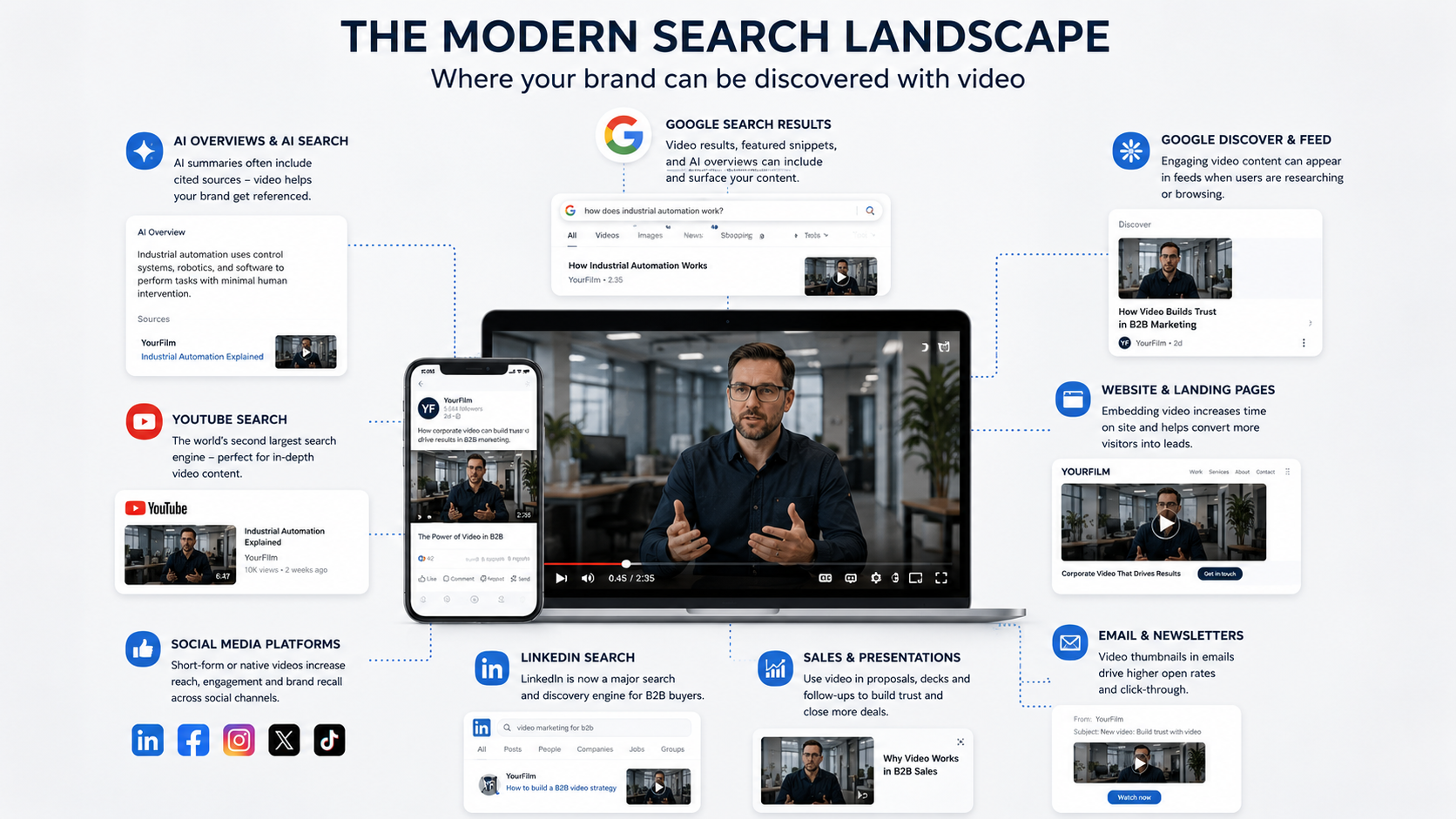
Video can help your brand appear across more discovery surfaces: Google video results, YouTube, LinkedIn, your website, email, sales conversations, social platforms, AI-cited content ecosystems and rich search experiences. It also gives people something AI cannot easily replace: real people, real expertise, real places and real customers, all factors which help to build trust.
Why Video Is Becoming More Important As Search Changes
Video is becoming increasingly important because search visibility has evolved from merely ranking a web page on the SERPs. It is about being discoverable, credible and useful across every platform your audience can use for answers.
That includes Google, YouTube, LinkedIn, AI search tools, social platforms, industry websites, email, sales content and your own website.
For B2B companies, this matters because buyers are not just searching for information. They are searching for confidence. They want to know who to trust, which solution makes sense, whether a supplier understands their problem and whether a company feels credible enough to partner with.
Written content can answer questions but video can show people, proof, process and personality behind the answer.
The Search Results Page Is More Crowded Than Ever
Traditional organic search results are no longer the only thing competing for attention.
A modern search results page may include:
- Sponsored ads.
- AI-generated answers.
- Featured snippets.
- People Also Ask boxes.
- Video results.
- Image results.
- Local results.
- Review platforms.
- Reddit or forum discussions.
- YouTube results.
- Knowledge panels.
- Shopping or product results.
For many commercial searches, the first organic website result can sit far lower on the page than it used to.
This means ranking well is no longer enough. A business may still technically rank on page one, but receive fewer clicks because the most visible areas of the page are occupied by ads, AI summaries and rich results.
That is why businesses need to think beyond “how do we rank?”
The better question is:
“How do we stay visible and trusted when search is no longer just a list of links?”
Video is one answer to that problem.
AI Search Can Summarise Static Content
AI-generated search responses are designed to answer questions quickly.
That can be useful for users, but it creates a challenge for businesses that rely heavily on written content.
If your article answers a question clearly, an AI system may summarise the answer directly in the search results. The user may get what they need without clicking through to your website.
This does not mean written content is pointless. It still matters for authority, education, SEO, website depth and AI citation potential.
But static content alone is becoming more vulnerable.
A written explanation can be summarised.
A real customer testimonial, manufacturing process, recruitment film, leadership interview, company culture video or behind-the-scenes production story is harder to flatten into a generic answer, even with access to the transcript.
Video gives your brand a richer form of evidence.
It allows people to see and hear the expertise, not just read about it.
Video Outperforms Static Content
-
- Viral Reach: Social video content generates 1200% more shares than text and static image posts combined.
- Click-Through Rates (CTR): Instagram Reels and TikTok videos outperform static images in CTR by 480% and 540% respectively.
- Platform Prioritisation: Video content earns roughly 25% more impressions than static ad placements on average.
- Ad Cost Efficiency: High-performing short-form video ads can deliver clicks that are up to 480% cheaper compared to static alternatives.
-
- Message Retention: Audiences retain 95% of a message when delivered via video, compared to just 10% when reading static text.
- Product Education: 99% of marketers report that video has directly improved user understanding of a product or service.
- Visual Processing: The human brain processes visual elements up to 60,000 times faster than plain text.
-
- Lead Generation: Video advertising creatives generate triple the leads when directly compared to standard static images.
- Direct Sales Impact: Video-based ads yield a 47% higher purchase rate than static, non-moving product posts.
- Consumer Preference: 78% of people prefer learning about a product via short video, while only 9% prefer reading static text articles.
- Purchase Intent: 82% of consumers state they have been fully convinced to buy a product or service after watching a brand’s video.
- Time on Site: Web pages containing integrated video retain visitors 3x longer, driving up average session durations by 47%.
- Search Engine Visibility: Video landing pages are 50x more likely to rank on the first page of organic Google search results than text-only pages.
Video Creates More Routes to Discovery
One of the biggest advantages of video is that it can live in more places than a standard written page, especially content which exists online as it has to be unique in order to not be penalised as duplicate content.
Google’s own video SEO documentation says video can appear in several places on Google, including the main search results page, Video mode, Google Images and Discover. Google also recommends dedicated watch pages, structured data, stable thumbnails and other technical steps to help video content become eligible for video features.
That matters because visibility is no longer about relying on one page to do all the work.
A strong video strategy gives your business more entry points.
- Someone might find you through a YouTube search.
- Someone might see a LinkedIn clip.
- Someone might watch a case study embedded in a proposal.
- Someone might land on a video-rich service page.
- Someone might discover your answer through a video result rather than a traditional blue link.
The more useful surfaces you appear on, the less dependent you are on static SERP rankings alone.
YouTube Is Also a Search Engine
Many B2B companies underestimate YouTube.
They think of it as a video hosting platform or a place for consumer entertainment. But YouTube is also where people search for explanations, comparisons, demonstrations, reviews, tutorials, product information, expert opinions and company insight.
For B2B, that creates an opportunity.
A buyer may search YouTube for:
- How a process works.
- What a service involves.
- How to choose between suppliers.
- What questions to ask before buying.
- How a product solves a specific problem.
- What a company culture is like.
- How other customers use a solution.
This is especially valuable when the subject is visual, technical or trust-based.
Manufacturing, construction, SaaS, professional services, recruitment, healthcare, education, engineering and technology companies can all benefit from making complex ideas easier to understand through video.
If people are searching in more places, your content needs to appear in more formats.
Video Builds Trust Faster Than Static Content
AI-generated answers can provide information but they cannot fully replace human trust.
In B2B, trust is often the difference between a visitor who reads and leaves, and a prospect who makes contact.
Video helps build that trust because it shows real signals of credibility.
Video can show:
- Real employees.
- Real customers.
- Real workplaces.
- Real products.
- Real processes.
- Real expertise.
- Real delivery standards.
- Real emotion and nuance.
The final point “real emotion and nuance” is particularly important as AI-generated content becomes more common. If the internet is flooded with generic written answers, the brands that show real people and real proof will feel more credible.
A buyer can read that your company is an expert in its field, your staff are reliable and experienced. But a video lets them see how your team speaks, how your process works, how customers describe the experience and whether the business feels like one they can trust.
That is hard to replicate with static content alone.
Video Helps Your Written Content Work Harder
This is not about replacing written content with video. It’s actually best approach is to combine both.
A strong video can make a written article, service page or case study more engaging. The written content supports search relevance and depth. The video adds trust, clarity and human connection.
For example, a B2B article about choosing a supplier could include a short expert video explaining the main decision criteria.
- A recruitment page could include employee interviews.
- A manufacturing service page could include footage of the production process.
- A case study could include a customer testimonial video.
- A product page could include a short explainer or demonstration.
This gives visitors different ways to understand the same message.
It also increases the usefulness of the page, which matters when search engines and AI systems are trying to identify content that genuinely answers user needs.
Video Can Help You Become the Source, Not Just Another Article
As AI search grows, businesses need to think about establishing themselves as a trusted source.
That means creating content with enough depth, specificity and credibility that it is worth referencing, sharing and remembering.
Generic articles are easy to replace. However, specific expertise is harder to replace.
Video can help establish expertise because it can capture original thinking and real experience. These assets provide stronger evidence than generic written claims ever could. They also give your written content more substance.
A video interview can become an article, an FAQ, a transcript, social clips, email content and sales material.
This is how video supports both SEO and broader visibility.
Video Is More Shareable Across Buyer Journeys
B2B buying decisions often involve multiple people.
One person may discover your company, but others may need to approve, compare or validate the decision.
Video is useful because it travels well across buying groups. Written content can also be shared, but video often reduces the effort required to understand the message.
In long B2B buying cycles, involving several extremely busy people, time matters.
Video helps your message move between people quicker, more clearly and consistently.
Video Makes Your Brand More Memorable
Search visibility is not only about being clicked.
It is also about being remembered.
As AI-generated summaries answer more informational queries, users may visit fewer websites during early research. That means when they do click, engage or shortlist suppliers, the brand needs to make an impression quickly.
Video can help because it gives your brand a face, voice and feeling.
A written page may explain what you do, however, a video can make the viewer remember who you are.
That is especially important in competitive B2B markets where many companies make similar claims.
Most suppliers say they are experienced, reliable, flexible, innovative and customer-focused.
Video gives you a chance to prove those qualities than simply stating them.
Video Supports AI Visibility Too
AI search does not remove the need for content. It changes what content needs to do.
AI systems still need sources. They still pull from web pages, videos, transcripts, structured data, trusted domains and recognisable entities.
Google’s video guidance recommends making videos discoverable with dedicated watch pages, clear metadata, structured data and stable thumbnail URLs. These steps help search engines understand the video and display it in richer search experiences.
For businesses, that means video should not just be uploaded and forgotten.
A properly optimised video should have:
- A clear title.
- A useful description.
- A transcript.
- A dedicated page where appropriate.
- Relevant surrounding written content.
- Structured data.
- A strong thumbnail.
- Captions.
- A clear call to action.
- Internal links.
This gives search engines more context.
It also gives AI-influenced systems more material to understand what your brand knows and why your content is relevant.
What Types of Video Help With Visibility?
The right video depends on the business goal, but several formats are especially useful for search visibility and trust.
1. Educational Videos
These answer the questions your audience is already searching for like:
- “How do you brief a video production company?”
- “What should a recruitment video include?”
- “What type of video should a B2B company make first?”
Educational videos work well because they match real search intent.
2. Explainer Videos
These help people understand complex products, services or processes.
They are very useful for B2B companies with technical, specialist or high-value offers.
3. Customer Testimonial Videos
These help build trust and reduce risk.
They are particularly useful when prospects are comparing suppliers.
4. Recruitment Videos
These improve visibility with candidates and help show the culture behind the company.
5. Thought Leadership Videos
These position your team as experts.
They can support LinkedIn, YouTube, articles, email and sales conversations.
6. Product or Process Videos
These are especially useful for manufacturing, technology, engineering and service-led companies where the process is difficult to explain with text alone.
The strongest strategy often combines several of these formats.
How to Use Video Alongside SEO
Video should be part of a wider visibility strategy, not a separate activity.
A practical approach could look like this:
- Start with the questions your buyers are already asking.
- Create a useful article that answers the question clearly.
- Film an expert answering the same question in a natural, human way.
- Embed the video on the article page.
- Add a transcript or supporting copy.
- Create short clips for LinkedIn and social media.
- Upload a search-optimised version to YouTube.
- Use the video in email and sales follow-ups.
- Measure both search performance and commercial usefulness.
This approach gives one idea multiple routes to visibility.
It also helps your content feel more original and human, which is increasingly important in a world of AI-generated summaries.
The Mistake: Making Video Without a Strategy
Video will not solve visibility problems automatically.
A poorly planned video that is never optimised, repurposed or distributed will not do enough.
The video needs a purpose.
It should be planned around:
- The audience.
- The search intent.
- The platform.
- The message.
- The call to action.
- The buyer journey.
- The distribution plan.
- The measurement.
The goal is not simply to “add video” to your marketing.
The goal is to make video part of how people discover, understand and trust your business.
Static Content Still Matters, But It Needs Support
Written content is not dead.
It is still essential for search, authority, accessibility, depth and conversion.
But static content on its own is under even more pressure than ever with the rise of AI. AI summaries can absorb informational answers. Sponsored ads can dominate high-intent searches. SERP features can push organic results even lower now, meaning a user will have to scroll to even see the top position organic search result.
Zero-click behaviour can reduce website visits, and competition for attention is getting even harder.
Video gives businesses another way to be found, remembered and trusted.
It makes content more useful and reusable. It makes pages more engaging. It creates social assets. It supports YouTube visibility. It helps sales teams. It gives AI and search engines richer context to reference. It shows real proof.
That is why video is becoming more important.
The Future of Search Is Multi-Format
B2B companies need to stop thinking of search as only written pages ranking in Google.
Search is becoming multi-format, multi-platform and increasingly AI-assisted.
- People search on Google.
- They search on YouTube.
- They search on LinkedIn.
- They ask AI tools.
- They look at forums.
- They watch short clips.
They compare suppliers through content before making contact. If your business only relies on static written content, you may become less visible in the places where attention is moving.
Video helps you meet buyers where they are.
It gives them something useful, human and credible to engage with.
So, why is video important now?
Because visibility is harder to earn, clicks are harder to win and trust is harder to build through written content alone.
Video helps your business show up in more places and make a stronger impression when it does.
In an AI-shaped search landscape, video is a crucial element to include in your brand visibility activity.