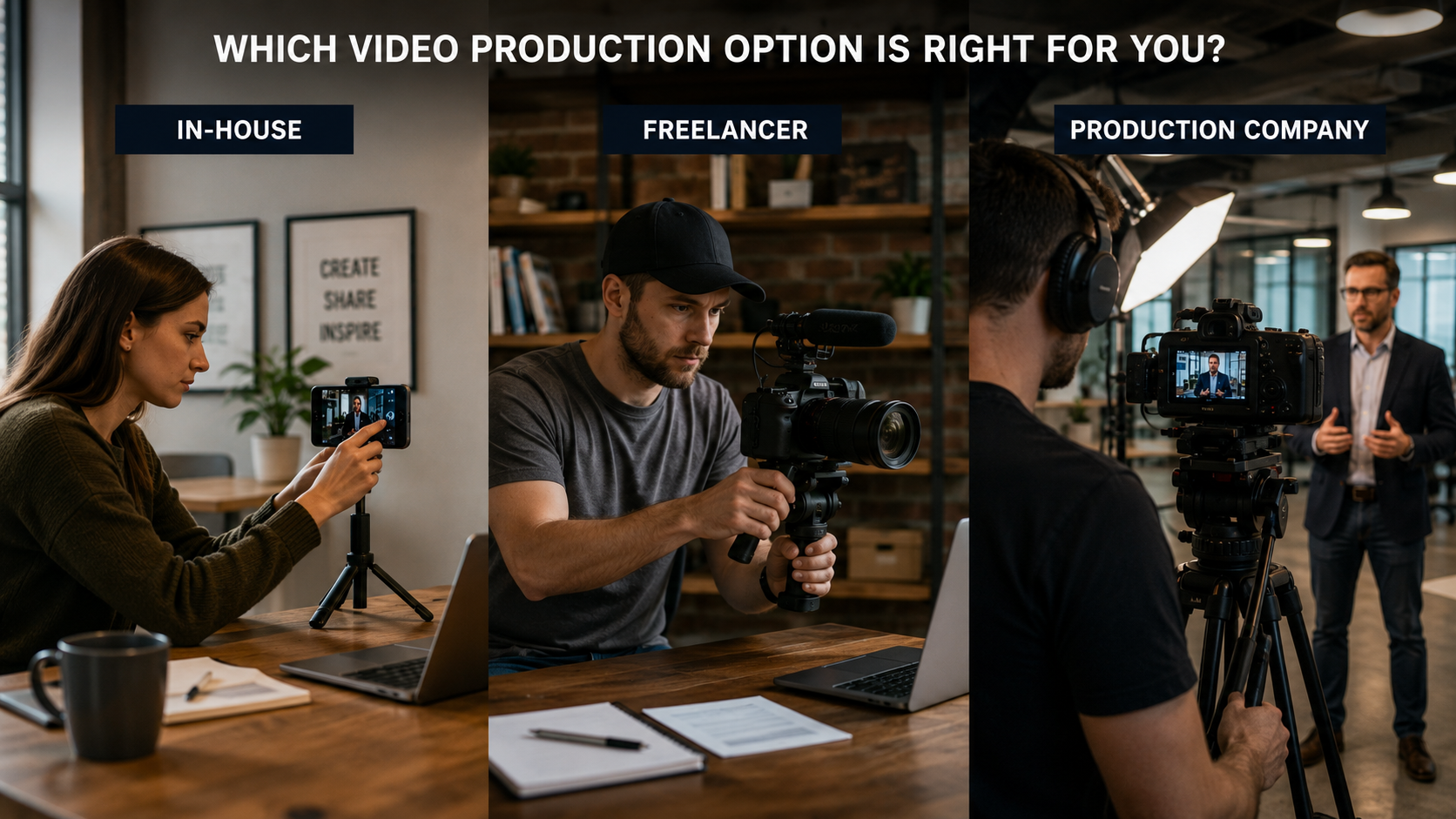
For many SMEs and B2B companies, the question is not simply whether to make video content.
It is who should make it.
Should you hire a video production company? Work with freelancers? Build an in-house setup? Or use a mix of all three?
It is a practical buying question, and it matters because not every video needs the same level of production. Some content should be quick, simple and authentic. Some content needs a specialist eye. Some content carries enough commercial weight that getting it wrong could cost more than doing it properly in the first place.
The honest answer is that there is no single right option for every business.
In-house video can be ideal for speed and volume. Freelancers can be a smart choice for specific tasks and smaller projects. A video production company makes sense when the project needs strategy, quality, planning, consistency and confidence.
The key is knowing which route fits the job.
If you are a B2B or B2C SME planning more video content, you have probably asked some version of this question:
Should we hire a video production company, use freelancers, or make videos ourselves?
It is a fair question.
Video is no longer something businesses create once every few years. It now supports marketing, sales, recruitment, internal communication, customer education, social media, events and brand building.
That does not mean every video needs a full production team.
Sometimes in-house is enough.
Sometimes a freelancer is enough.
And sometimes hiring a video production company is the option that saves money, protects quality and gives the video the best chance of actually working.
The decision should not start with who is cheapest. It should start with what the video needs to achieve.
Start With the Purpose of the Video
Before deciding who should make the video, decide what the video needs to do.
- Is it designed to generate leads?
- Support a sales conversation?
- Build trust with potential customers?
- Attract candidates?
- Explain a complex product or service?
- Launch something new?
- Capture an event?
- Create regular social content?
- Communicate internally?
The answer changes the best production route.
A quick behind-the-scenes clip for social media probably does not need a production company. A customer story that will sit on your website, support sales and influence new business conversations probably does.
The more commercially important the video is, the more important planning, messaging, sound, lighting, structure and editing become.
That is where the differences between in-house, freelancers and production companies really start to matter.
When In-House Video Is Enough
In-house video can be brilliant.
For regular, lower-risk content, it often makes complete sense. If the goal is speed, authenticity and volume, an internal team or even a confident employee with a phone can often produce useful content.
In-house video works well for:
- Quick social media updates.
- Behind-the-scenes clips.
- Internal messages.
- Simple product demos.
- Event snippets.
- Recruitment day content.
- Founder or team updates.
- Informal company culture content.
This kind of video does not always need to be polished. In fact, it can sometimes work better when it feels immediate and natural.
A short clip filmed on a phone can feel more authentic than a heavily produced campaign film, especially on platforms like LinkedIn, Instagram or TikTok.
In-house production is also useful when the business needs to move quickly. You do not need to brief an external team, schedule a shoot or wait for a production slot. You can react to what is happening in the business and publish content regularly.
For SMEs, that consistency can be valuable.
But there are limits.
The danger is assuming that because something can be filmed in-house, it should be.
As soon as the video becomes more important, the gaps can start to show. Not just in camera quality, but in planning, sound, lighting, structure, editing, storytelling, brand consistency and knowing what to leave out.
In-house video is great for volume.
It is not always the best option for high-stakes content.
When Freelancers Are Enough
Freelancers can be a very good middle ground.
If you have a clear brief, a defined output and someone internally who can manage the process, a good freelancer may be exactly what you need.
Freelancers are often ideal for:
- Event filming.
- Simple interviews.
- Social cutdowns.
- Photography and video days.
- Drone footage.
- Editing support.
- Animation support.
- Specific specialist tasks.
A freelancer can be more flexible and cost-effective than a full production company, particularly when the project is straightforward.
For example, if you already know what you need filmed, where it will be filmed, who is involved and what the final edit should look like, a freelancer can be a smart choice.
They can bring professional equipment, technical skill and production experience without the larger structure of an agency or production company.
But there is a trade-off.
A freelancer is usually one person. They may be excellent at filming but less experienced in strategy. They may be strong at editing but not able to support with scripting, messaging, logistics, campaign planning, animation, versioning or stakeholder management.
That is not a criticism. It is simply the nature of the role.
If you hire a freelancer, you may still need to manage the creative direction, brief, schedule, shot list, contributors, locations, feedback process and final delivery requirements.
For some businesses, that is fine.
For others, it becomes more work than expected.
Freelancers are often the right choice when the task is specific, the brief is clear and your internal team has the time and confidence to manage the process.
When a Video Production Company Makes Sense
A video production company becomes valuable when the project needs more than someone to capture footage.
That might be because the video is strategically important, creatively demanding, logistically complex or needs to work across multiple channels.
A production company is usually the right fit for:
- Brand films.
- Customer stories.
- Recruitment campaigns.
- Product explainers.
- Animation.
- Campaign content.
- Multi-location shoots.
- High-profile internal communications.
- Sales enablement videos.
- Launch videos.
- TV adverts.
Content that needs multiple edits and formats.
This is where the value is often misunderstood.
You are not just paying for cameras. You are paying for the thinking around the video.
- What should it say?
- Who is it for?
- What does the audience need to understand?
- Where will the video be used?
- What format should it take?
- What can be captured now and reused later?
- What risks need managing before the shoot?
- What will actually make this useful?
That planning matters.
A production company should help shape the message, plan the shoot, manage logistics, direct interviews, capture the right footage, handle the edit and deliver versions that work across the platforms you need.
For SMEs and B2B companies, this can be the difference between simply having a video and having a video that supports sales, recruitment or marketing properly.
The Hidden Cost of Cheap Video
Every business needs to be sensible with budget.
But cheap video can become expensive if it needs to be fixed, reshot or quietly abandoned.
This often happens when a company starts with the idea that it “just needs something.”
Then later, the problems appear.
- The message is not clear.
- The sound quality is poor.
- The footage does not match the brand.
- The wrong people were interviewed.
- The edit does not hold attention.
- There are no cutdowns for social media.
- The video does not work on the platform it was made for.
- Nobody thought about the call to action.
- The finished asset does not support sales, recruitment or marketing.
The result is frustrating. The business either does not use the video properly, or it pays again to do it right.
That is not value. That is false economy.
Hiring a production company is rarely the expensive mistake when the project is important. The expensive mistake is creating a video that does not work.
A good production partner can often save money by helping you avoid wasted filming time, unclear messaging, poor planning and missed opportunities.
The Best Option May Be Hybrid
For many B2B companies, the best answer is not one route forever.
It is a hybrid approach.
- In-house teams can create regular, authentic content.
- Freelancers can support specific shoots, edits or specialist requirements.
- A production company can handle the higher-value projects that need strategy, structure and stronger creative direction.
This approach often works well because different types of video have different jobs.
Your in-house team might capture weekly social content.
A freelancer might film an event or create short edits.
A production company might produce your brand film, recruitment campaign, customer story or product launch video.
That gives you the best of each option: speed, flexibility and quality where it matters most.
The important thing is to avoid treating all video content the same.
A quick social post and a flagship customer case study should not have the same process, budget or expectations.
How to Decide Which Route Is Right
A simple way to decide is to look at the risk and importance of the video.
If the video is low-risk, short-lived and needs to be produced quickly, in-house may be enough.
If the video has a clear brief and needs professional support on a specific task, a freelancer may be enough.
If the video needs to persuade, explain, recruit, build trust or represent your brand at a high level, a production company is usually the safer choice.
Ask yourself:
- Will this video influence a buying decision?
- Will it sit on the website for a long time?
- Will sales teams use it with prospects?
- Will it affect how candidates see the company?
- Will senior stakeholders need to approve it?
- Will it be used across multiple platforms?
- Would getting it wrong cost more than getting it right?
If the answer is yes, it is worth investing in proper planning and production.
Be Honest About What You Need
The best production route depends on the job.
Not every video needs a production company, and any good production partner should be honest enough to say that.
Some content should be made quickly in-house. Some projects are ideal for freelancers. Some videos need the structure, strategy and quality control of a production company.
The real question is not:
“Can we make this cheaper?”
It is:
“What does this video need to achieve, and what level of support gives it the best chance of working?”
For SMEs, that distinction matters.
Because the goal is not just to make video.
The goal is to make video that achieve your objectives.