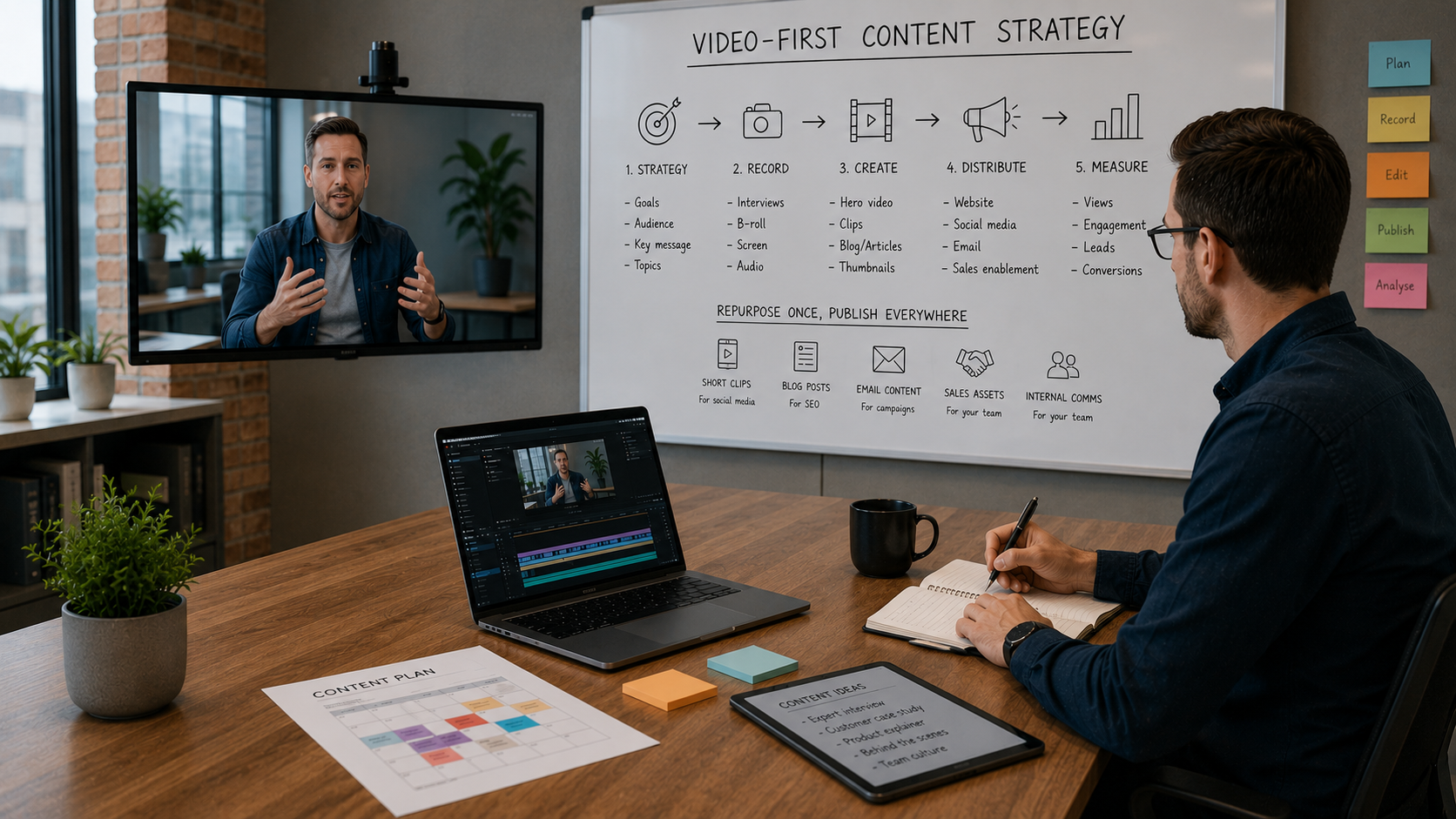
A video-first content strategy does not mean every piece of marketing has to be a video.
It means video becomes the starting point for a smarter, more efficient content system.
Instead of creating a blog here, a LinkedIn post there, a campaign video later and a few social clips when someone has time, a video-first strategy begins with one strong video idea and turns it into multiple useful assets.
For B2B companies, this is especially valuable. A single well-planned video shoot can create website content, social media clips, sales enablement assets, recruitment material, email content, blog ideas, paid ad creative and internal communications.
That is the difference between “making videos” and building a content engine.
Video-first works because video captures more than just information. It captures people, tone, expertise, trust, emotion, process, environment and proof. From there, the content can be edited, repurposed and distributed across the channels where your audience actually spends time.
With 91% of businesses now using video as a marketing tool, video is no longer a nice extra. The opportunity is not simply to use video. It is to use it more strategically.
How To Build An Effective Video-First Content Strategy
An effective video-first content strategy starts with one clear business goal, one defined audience and one strong core idea. From there, you plan the main video, capture supporting content and repurpose it into multiple assets for different platforms, stages of the buyer journey and internal teams.
The key word is strategy.
Video-first does not mean filming everything and hoping to find useful content later. It means planning from the beginning so that every shoot, interview, story and edit has a job.
For a B2B company, a video-first strategy should help them achieve at least one of the following:
- Generate better leads.
- Build trust with buyers.
- Support the sales team.
- Attract the right candidates.
- Explain complex products or services.
- Improve visibility online.
- Create consistent social content.
- Launch something new.
- Educate customers.
- Strengthen brand perception.
If video is not connected to a real business goal, it quickly becomes content for content’s sake.
What Does Video-First Actually Mean?
Video-first means treating video as the primary content source.
A traditional approach might start with written content, then create a video version later. A video-first approach does the opposite. It starts with a conversation, interview, demonstration, customer story, product explanation, webinar, podcast, event or brand film, then turns that video into other formats.
For example, one expert interview could become:
- A long-form YouTube video.
- A short LinkedIn clip.
- A blog article.
- Several social posts.
- An email campaign.
- A quote graphic.
- A sales follow-up clip.
- A paid advert.
- An FAQ section.
- A short vertical video.
- A website page asset.
The original video becomes the source material.
This works well because video contains a lot of reusable value. You can pull out the strongest answers, moments, explanations, stories, visuals and soundbites, then adapt them for different platforms.
The result is a more efficient content system.
Why B2B Companies Should Think Video-First
B2B buying decisions are often slow, careful and complex. Buyers need clarity, proof and trust before they take the next step.
Video helps because it can show the people behind the business, simplify complicated messages and make expertise easier to understand.
But the biggest advantage of a video-first strategy is not just that video performs well. It is that it gives the business more useful content from the same effort.
A B2B company may struggle to create regular content because every piece needs input from busy experts, sales teams, leadership or customers. Video-first helps solve that problem.
Instead of asking subject matter experts to write repeated articles, you can interview them once and turn that conversation into a whole set of content assets.
Instead of asking a customer for multiple approvals across several formats, you can film one strong customer story and create approved clips for website, social, sales and email campaigns.
Instead of building each campaign from scratch, you can create a central video asset and then build the surrounding content around it.
This saves time, improves consistency and keeps the message focused.
Start With the Business Goal
Before choosing a video format, define the goal.
What does the business need the content to achieve? Is it:-
- More qualified enquiries.
- Better sales conversations.
- Stronger recruitment.
- More trust in the brand.
- Higher visibility in a specific sector.
- Clearer explanation of a service.
- Support for a new product launch.
- Better customer education.
- More consistent LinkedIn activity.
This matters because a video-first strategy is not just about creating more content. It is about creating content that generates the right outcome.
If the goal is to create leads, then the content should focus on buyer problems, pain points and useful next steps.
If the goal is to build trust, then the content should include customer proof, testimonials, case studies or behind-the-scenes credibility.
If the goal is to recruit new talent for the workforce, then the content should focus on real employees, culture, progression and the candidate’s needs.
If the goal is to educate your audience, then the content should explain clearly and answer common questions.
The goal shapes everything.
Define the Audience Properly
A video-first strategy should not speak to “everyone.” It should speak to a specific audience with a specific need.
For example, targeting existing customers could be your goal. It is important to understand that these existing customers are a completely different audience to your potential customers. All your video content should speak to these audiences differently.
A senior decision-maker may want commercial value and confidence. A technical buyer may want proof and detail. A candidate may want honesty about culture and progression. A procurement team may want reassurance around reliability and risk.
The more clearly you define the audience, the more useful the content becomes.
Ask yourself the following questions:
- What does this audience already know?
- What do they misunderstand?
- What question keeps coming up?
- What would make them trust us?
- What would make them hesitate?
- Where do they spend time online?
- What format are they likely to engage with?
This is where many businesses go wrong. They create video content about themselves rather than video content which a specific audience would appreciate.
A video-first strategy should always be audience-led.
Choose a Core Video Theme
Once the goal and audience are clear, choose one core theme. This is the central idea that the content will be built around.
For example this could be:
- How manufacturers can reduce downtime.
- What candidates should know before joining our engineering team.
- How our product helps finance teams improve reporting.
- Why customer onboarding fails and how to fix it.
- What buyers should ask before choosing a supplier.
- How our team delivers complex projects safely.
A strong theme should be specific enough to attract the right audience, but broad enough to create several related pieces of content.
Avoid themes that are too generic, such as “our company,” “our services” or “why we are different.” Those can be useful, but they often become too company-centred.
A better theme starts with the audience’s problem, question or goal.
Build Around a Hero Video
The most successful video-first strategies are developed around a central asset.
This is often called a hero video, but it does not always have to be a big brand film. It could be a customer story, expert interview, webinar, product explainer, recruitment film, leadership discussion or campaign video.
The hero video gives the campaign its main message and is the foundation for all subsequent content.
It should answer the main question, explain the key message and provide enough useful material to create shorter assets.
The true value comes from planning the hero asset from inception.
Capture With Repurposing in Mind
Repurposing should not be an afterthought.
If you want multiple assets from one shoot, you need to plan for that before filming.
That means thinking about:
- Which questions will create useful short clips.
- Which answers could work as standalone social posts.
- Which shots will support website edits.
- Which vertical shots may be needed for mobile platforms.
- Which clips sales teams might send to prospects.
- Which moments could work in paid adverts.
- Which stills or thumbnails are needed.
- Which captions, graphics or text overlays may be required.
A common mistake is filming one widescreen video, then later trying to force it into every other format. That often leads to awkward crops, weak scenes and clips that do not feel native to the platform.
A proper video-first strategy plans the outputs first, then captures the material needed to create them.
Google’s own video SEO guidance also stresses the importance of making videos discoverable through indexable pages, metadata, stable thumbnails and structured data, so the technical side of distribution should be considered early too.
Turn One Video Into Multiple Assets
The power of video-first content is multiplication.
One strong video can become a full campaign. This does not mean every piece of content should say the same thing in the same way, in fact we encourage diversity in the messaging. Each version should be adapted for its platform and purpose.
The same core story can work across several touch points if it is edited properly.
Map Content to the Buyer Journey
A video-first strategy should think about the platforms on which it will be viewed, but more importantly it should think about the buyer journey.
Different videos are useful at different stages of this journey.
- At the awareness stage, the audience may need content that names the problem, explains a trend or introduces a useful idea.
- At the consideration stage, they may need explainers, service videos, webinars, comparisons or expert insights.
- At the decision stage, they may need testimonials, case studies, product demos, proposal videos or leadership reassurance.
- After purchase, they may need onboarding videos, training content, customer updates or support material.
This matters because not every piece of video content should be designed to generate an immediate enquiry.
Some videos will serve the purpose of creating awareness, others build trust.
Some educate, others remove objections.
Some help to close deals, others help with aftercare.
A real strategy defines the role of each asset.
Use Video to Support Sales, Not Just Marketing
A video-first strategy should aid both marketing and the sales.
Sales teams can often get huge value from video content.
They can use clips to support proposals and overcome objections. When developed correctly, a video of this nature is a powerful tool. A beautifully crafted sales orientated video can help internal champions persuade colleagues and key decision makers, effectively closing the deal for you.
It is best to involve your sales team in the video content strategy as early as possible. They know the questions buyers ask. They know where deals slow down. They know which proof points matter.
A good video-first strategy incorporates these insights.
Make Content Platform-Specific
A video-first strategy does not mean posting the same video everywhere.
Each platform has different expectations.
- LinkedIn content should usually be clear, useful and easy to understand without sound.
- YouTube content can be longer, more searchable and more educational.
- The website version of the videos should support the page they are on and guide visitors towards action.
- Email videos should be focused and relevant to the recipient’s stage in the journey.
- Instagram and TikTok may need vertical, faster-paced edits depending on the audience.
- Paid ads need immediate clarity and a strong reason to keep watching.
- Sales videos need to be concise, proof-led and easy to share.
The message should stay consistent, but the edit should fit the platform.
That is what makes the content feel intentional rather than a recycled afterthought.
Build SEO Into the Strategy
Video-first content can support SEO when it is planned properly.
A video can become the basis for a search-focused article, FAQ section, landing page, transcript, YouTube description and supporting social posts.
For YourFilm-style B2B content, this matters because many potential buyers search for practical questions before they contact a production company.
Questions such as:
- What type of video should a B2B company make first?
- How do you brief a video production company?
- Is video marketing worth it for B2B?
- What should a recruitment video include?
- How much does video production cost?
- Should we use AI video or professional video?
Each of those questions can become a video, an article and a set of shorter clips.
For video SEO specifically, Google recommends helping search engines discover video content through metadata, structured data, video sitemaps, Open Graph tags, indexable watch pages and stable thumbnail URLs.
That means SEO should not be added at the end. It should influence the topic, title, page structure, transcript, thumbnail, description and supporting copy from the beginning.
Create a Content Calendar From the Shoot
A video-first strategy should create consistency.
After a shoot, you should not only have final video files. You should have a distribution plan.
For example, one monthly filming session could create:
- One main video.
- Four LinkedIn clips.
- Two vertical shorts.
- One blog article.
- One email newsletter.
- Three sales snippets.
- Several stills or thumbnails.
- One internal update.
That gives the business content to publish over several weeks rather than one isolated launch moment.
The calendar should define:
- What will be posted.
- Where it will be posted.
- Who it is for.
- What message it supports.
- What call to action it includes.
- How performance will be measured.
This turns video from a one-off asset into a repeatable content system.
Measure the Right Things
A video-first strategy needs measurement, but the metrics should match the goal.
- If the goal is awareness, views, reach and watch time may matter.
- If the goal is lead generation, landing page engagement, enquiries and conversion rate may matter.
- If the goal is sales enablement, usage by the sales team, prospect feedback and deal progression may matter.
- If the goal is recruitment, applications, candidate quality and careers page engagement may matter.
- If the goal is trust, testimonial usage, proposal support and stakeholder confidence may matter.
The mistake is judging every video by the same metric, or attributing all credit to the last click.
A customer testimonial does not need to go viral to be valuable. A recruitment clip does not need thousands of views if it helps attract the right candidates. A sales video may be successful if it helps a handful of high-value prospects move forward.
Measure usefulness, not just visibility.
Keep the Strategy Focused
Start with one priority and build on it.
For example:
- We want to help manufacturing buyers understand our capability.
- We want to attract graduate engineers.
- We want to build trust with enterprise prospects.
- We want to explain our new service clearly.
- We want to create consistent thought leadership for LinkedIn.
Once that priority is clear, build the video content around it.
The more focused the strategy, the easier it is to create content that feels relevant.
What an Effective Video-First Strategy Looks Like in Practice
Here is a simple structure a B2B company could follow:
- Choose one business goal.
- Define one main audience.
- Identify the key question or problem.
- Create one hero video around that theme.
- Plan supporting clips before filming.
- Capture interviews, b-roll, BTS, stills and platform-specific footage.
- Edit the main video.
- Create shorter cutdowns for social, sales and email.
- Turn the transcript or key ideas into an article.
- Optimise the video page for SEO.
- Publish across the right channels.
- Track performance based on the original goal.
- Review what worked.
- Repeat with the next theme.
- This is not complicated, but it does require planning.
The strongest content strategies are not built by constantly starting from scratch. They are built by capturing valuable thinking once and using it intelligently.
The Best Video-First Strategy Starts With Usefulness
Video-first content works best when it is genuinely useful.
That means answering real questions, showing real expertise, solving real problems and helping the audience make better decisions.
For B2B companies, the goal is not to create endless, meaningless content. The goal is to create content that earns attention because it is relevant.
A video-first strategy helps you do that by turning strong ideas into a connected set of assets that support marketing, sales, recruitment and customer communication.
So, how do you build an effective video-first content strategy?
- Start with the business goal.
- Understand the audience.
- Create one strong video idea.
- Plan the outputs before filming.
- Repurpose with purpose.
- Distribute properly.
- Measure what matters.
That is how video becomes more than a one-off asset, it becomes the engine behind all your content strategy.