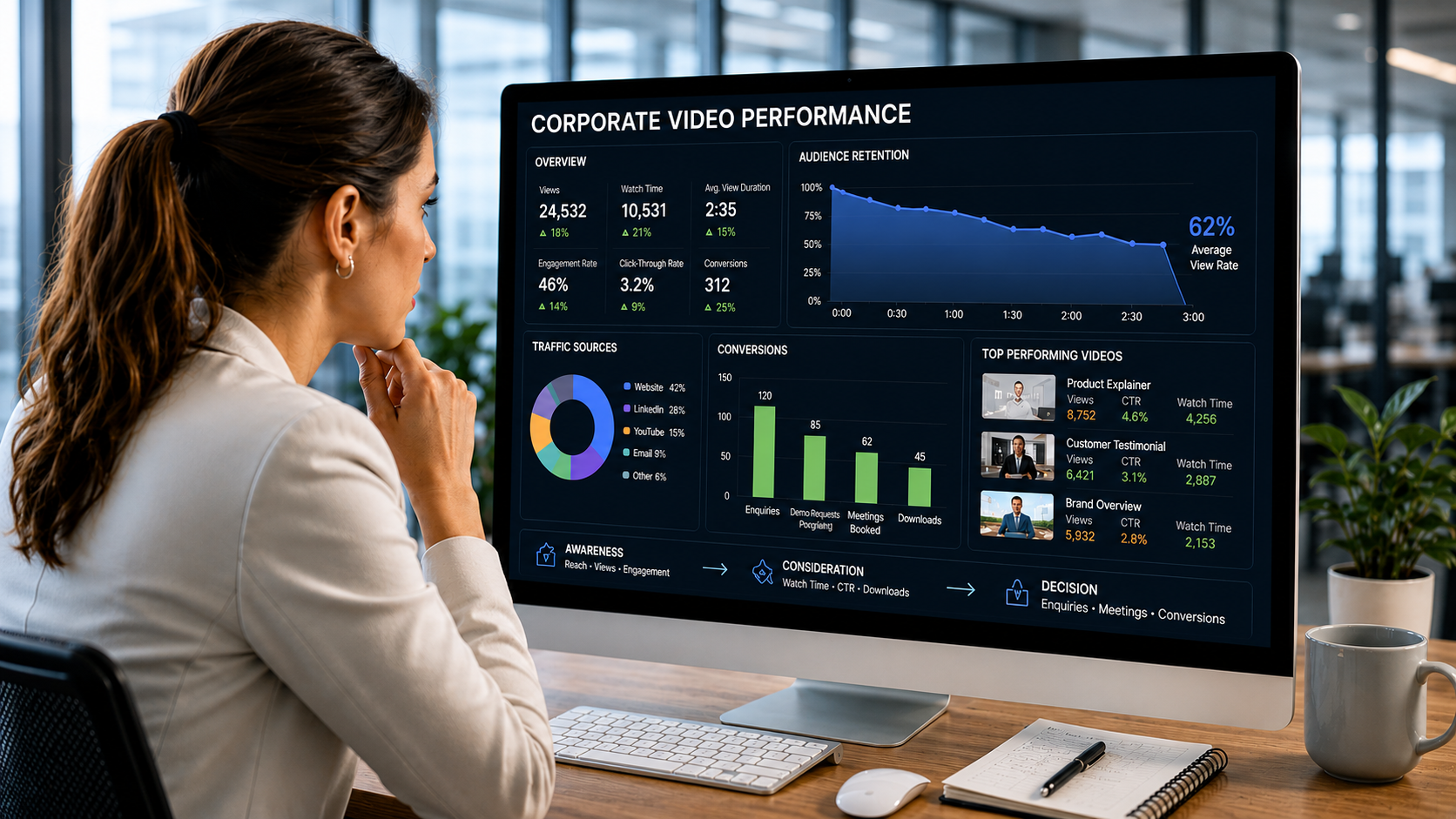
A corporate video is only successful if it helps the business achieve something measurable. Views can be useful, but they are not enough on their own.
For B2B companies, video should be measured by how it supports awareness, engagement, trust, sales conversations, recruitment, enquiries and revenue.
How To Measure Success From a Corporate Video
To effectively measure the success of a corporate video you must start with the purpose of the video.
A brand film, recruitment video, customer testimonial, product explainer, sales enablement clip and launch film shouldn’t be judged by the same metrics. They each sit in different parts of the sales and marketing funnel and are designed to influence different decisions.
The mistake is treating “success” as one outcome. Most commonly, that outcome is the number of views which the video generates.
Views tell you whether the video was seen. They don’t tell you whether the intended people have watched it, whether they understood the message, whether they trust the business more, whether they took action, or whether the video helped to enhance sales or recruitment.
For B2B companies, the better question is:
What job was this video created to do and did it achieve its objective?
Once that is clear, measurement becomes much easier.
Start With the Objective
Before measuring a corporate video, define the objective.
The video might be designed to:
- Increase brand awareness.
- Explain a product or service.
- Improve website engagement.
- Generate enquiries.
- Support sales conversations.
- Build trust with buyers.
- Attract candidates.
- Improve internal communication.
- Support a launch.
- Help customers understand a process.
Each goal needs a different measurement approach. If the goal is awareness, then views and reach matter, however, if the goal is engagement, watch time and completion rate matter.
If the goal is lead generation, enquiries and landing page conversion matter the most. If the goal is recruitment, applications and candidate quality are the barometer of success. If the goal is sales enablement, usage by the sales team and deal influence determine how effective and therefore successful the video is.
A corporate video should never be measured in isolation from its purpose.
Top of Funnel: Measuring Awareness and Reach
Top-of-funnel videos are designed to make people within your target audience aware of your business.
These might include brand films, thought leadership clips, social videos, campaign teasers, launch content or industry-focused explainers.
At this stage, the viewer may not be ready to buy. The goal is visibility, recognition and relevance. The aim of the video is to build trust and recall so that when the viewer is at the buying stage of the customer journey they remember your brand.
Useful metrics include reach, impressions, views, unique viewers, social engagement, follower growth, traffic from video platforms and brand search uplift.
But these numbers need context.
A video seen by 500 relevant decision-makers is much more valuable than a video seen by 50,000 irrelevant viewers. B2B audiences are usually smaller and more specific than B2C audiences. That means quality of reach matters more than just volume.
A top-of-funnel video is effective if it puts your brand in front of the right audience and creates a reason for them to pay attention.
Mid-Funnel: Measuring Engagement and Understanding
Mid-funnel videos help people understand, compare and trust the business.
These videos might be service explainers, product videos, customer stories, webinars, recruitment films, technical explainers and sector-specific content.
At this stage, views alone become even less useful.
The better indicators are watch time, average percentage watched, completion rate, click-through rate, website dwell time, repeat views, scroll depth, engagement with surrounding page content and follow-up actions.
Research on online video engagement has argued that time spent watching and percentage watched can be more useful than views alone when judging attention and quality.
For B2B companies, mid-funnel video is often about education. If people are watching most of the video, staying longer on the page and moving to related content, the video is doing its job.
It is helping them understand.
Bottom of Funnel: Measuring Enquiries, Meetings and Sales Influence
Bottom-of-funnel videos are designed to help people take action.
These videos are often case studies, testimonials, product demos, proposal videos, sales enablement clips, comparison videos and customer proof content.
At this stage, success should be measured closer to commercial outcomes.
Useful metrics will include enquiry volume, enquiry quality, demo requests, booked meetings, proposal conversion, sales team usage, influenced pipeline, assisted conversions, deal progression, close rate and feedback from prospects.
This is where attribution can be harder to measure.
A buyer may watch a testimonial, speak to sales two weeks later, share the video internally, review a proposal and then convert. The video may not get the credit for the conversion, but it would have strongly influenced the decision.
That is why B2B video measurement should include both analytics and human feedback.
Ask the sales team whether prospects mention the video. Track whether proposals containing video perform better. Monitor whether case study videos help move cautious buyers forward. Look at whether video-supported landing pages convert better than pages without video.
The goal is not to prove that one video caused one sale in isolation.
The goal is to understand whether video helps move qualified buyers through the process.
Recruitment Videos Need Different Metrics
Recruitment videos should not be measured like sales videos.
A recruitment video might be successful if it improves the quality of applications, helps candidates understand the culture, increases careers page engagement, supports recruiter outreach or reduces poor-fit applicants.
Useful metrics to observe will be career page views, video completion rate, application starts, completed applications, candidate quality, source of application, interview attendance, offer acceptance rate and the quality of candidate feedback.
For employer brand content, comments and shares can also be important, but only if they come from the right audience.
The most useful question is not “how many people watched it?”
It is:
Did the right candidates understand the opportunity better?
Sales Enablement Videos Need Internal Measurement
Some of the most valuable B2B videos are not designed for public performance.
A sales enablement video may not generate a huge amount of views, but that could be because it’s only been sent to qualified prospects, or used in proposals.
That does not make it any less valuable.
For sales enablement, measure how often the video is used, who uses it, which prospects receive it, whether it improves response rates, whether it helps explain the offer, and whether it supports later-stage opportunities.
Sales team feedback is essential here.
If a video helps salespeople explain the proposition faster, answer common objections, share customer proof or keep a deal moving, that is meaningful success.
A low-view sales video can be more valuable than a highly-viewed awareness clip, if it influences serious opportunities.
Website Video Should Be Measured by Behaviour
If a corporate video sits on a website, measure what happens around it.
- Does the page hold the visitor’s attention for longer?
- Do visitors scroll further than before the video was introduced on the page?
- Do they click through to another page?
- Do they complete a form?
- Do they watch the video before taking action?
- Do returning visitors engage with the video?
- Do video pages outperform non-video pages?
This helps demonstrate whether the video improves the website experience.
For a homepage video, success might mean stronger engagement and clearer brand understanding. For a service page video, success might mean more enquiries for that particular service.
The page context matters.
Do Not Ignore Qualitative Feedback
Not every valuable insight can be captured in your analytical data.
B2B video often influences perception, trust and confidence. Those are harder to measure, but still important.
Qualitative feedback can come from sales calls, customer conversations, candidate interviews, stakeholder comments and comments left on the video itself.
This kind of feedback should not replace data, but enhance the data which you can measure.
A corporate video may not produce a huge spike in enquiries, but if it improves the quality of conversations and the average order value, then that is success.
Build Measurement Into the Brief
The best time to decide how to measure a video is before production starts.
Measurement should be part of the brief.
Define the goal, audience, distribution plan, call to action and success metrics before filming. That way, the video can be built to achieve the right outcome.
For example, if the goal is lead generation, the production should consider the landing page, call to action, edit length, platform versions and follow-up journey.
If the goal is sales enablement, the production should consider objections, proof points, internal sharing and CRM tracking.
Measurement is not something to add after launch.
It should shape the video from the beginning.
Use Funnel-Based Measurement
A mature B2B video measurement framework separates metrics by funnel stage.
At the top of the funnel, it measures visibility.
At the middle of the funnel, it measures engagement and understanding.
At the bottom of the funnel, it measures action and influence.
We also need to consider the role of the video. For recruitment, we should be measuring candidate behaviour.
For sales enablement, measure sales conversions and deal support.
This prevents one common mistake: judging every video as if it should generate direct leads immediately.
Not every video has that job, and each should be measured against its role.
The Right Metrics for Corporate Video
A useful corporate video measurement framework should include the following:
- Awareness: reach, impressions, views, unique viewers, brand search, social engagement.
- Engagement: watch time, completion rate, percentage watched, dwell time, repeat views.
- Action: clicks, enquiries, demo requests, applications, downloads, meeting bookings.
- Sales influence: CRM notes, proposal usage, assisted conversions, deal progression, close rates.
- Recruitment: careers page engagement, application quality, offer acceptance, candidate feedback.
- Trust: prospect comments, testimonial usage, stakeholder feedback, customer conversations.
Please note that this list should not be used all at once. Choose the metrics that match the goal.
Summary
Corporate video success should not be measured by views alone.
Views only show exposure, not impact.
For B2B companies, video should be measured by its role in the funnel. Top-of-funnel videos should be judged by visibility and relevance. Mid-funnel videos should be judged by engagement, understanding and trust. Bottom-of-funnel videos should be judged by enquiries, meetings, sales influence and conversions.
Recruitment videos need candidate-focused metrics. Sales enablement videos need conversion-focused metrics.
The most useful measurement starts before production. Define the goal, audience, distribution plan and success metrics in the brief. Then judge the video based on whether it achieves the objective it was created for.