The Evidence
Video is now a mainstream marketing tool. Wyzowl’s 2026 data report states that 91% of businesses use video as a marketing tool, and 93% of marketers say video is an important part of their overall strategy. But using video is not the same as having a video strategy.
For B2B companies, a real video strategy connects video to the buyer journey, sales process, recruitment needs, trust-building moments and distribution channels.
It is not about making more video for the sake of it.
It is about making the right videos for the right people at the right stage of their journey.
Why Most B2B Companies Are Getting Video Wrong
….And What A Real Strategy Looks Like
Most B2B companies get video wrong because they treat it as a production task rather than a business communication tool.
- They start with the output.
- “We need a video.”
- “We need something for LinkedIn.”
- “We need a homepage film.”
- “We need a case study.”
Those are not bad ideas, but they are not a strategy.
A real strategy starts earlier. It asks what the business needs video to achieve, who the audience is, what they need to understand, where the video will be used and how it will support a commercial outcome.
That might be lead generation, recruitment, sales enablement, buyer trust, product education, internal communication, launch activity or customer retention.
The problem isn’t that B2B companies do not value video. The problem is that they often commission video without a clear system for why each piece exists and how it connects to the wider business.
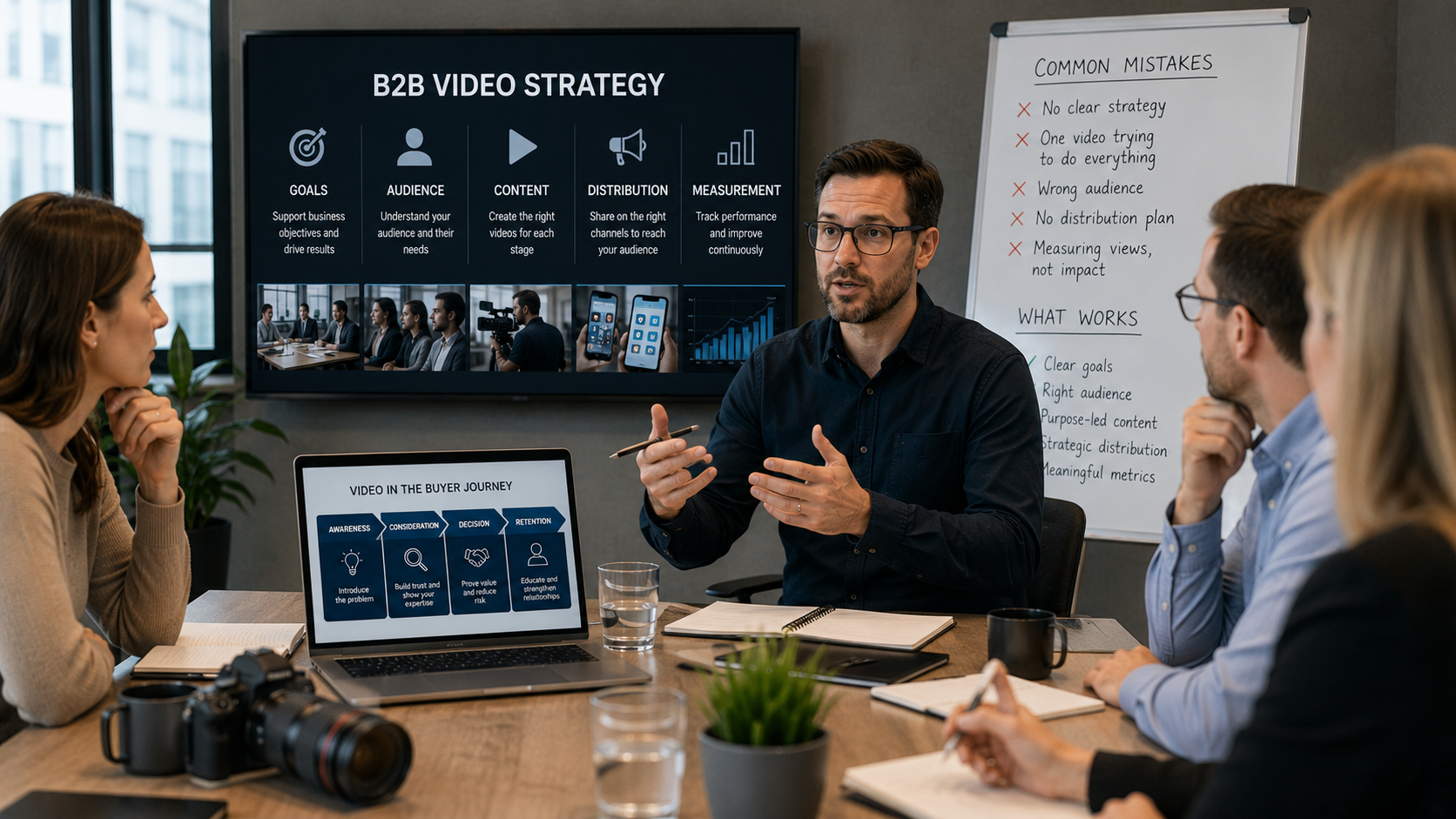
Mistake 1: Making One Video Do Everything
One of the most common B2B video mistakes is trying to make one video serve every purpose.
The company wants it to explain the business, introduce the team, attract candidates, generate leads, show culture, support sales, cover every service, impress senior stakeholders and work on every platform.
That is too much.
When a video tries to speak to everyone, it usually ends up not communicating to anyone.
A CEO, a technical buyer, a procurement manager, a graduate candidate and an existing customer do not require the same message. They all have different concerns, different levels of knowledge, different needs and different reasons to care.
- A brand film might need to communicate credibility and positioning.
- A sales enablement video might need to handle objections.
- A recruitment video might need to show culture and progression.
- A product explainer might need to simplify complexity.
- A customer story might need to reduce risk.
Those are different jobs.
A real strategy accepts that one video cannot do everything. Instead, it builds a small ecosystem of focused assets that each have a clear role.
Mistake 2: Starting With the Format Instead of the Goal
A lot of businesses start by asking what type of video they should make.
- Should it be a brand film?
- Should it be an explainer?
- Should it be a testimonial?
- Should it be short-form social content?
The better question is: what problem are we trying to solve?
- If the goal is to attract better candidates, the answer may be an employer brand film or role-specific recruitment clips.
- If the goal is to help buyers trust the company, the answer may be a customer case study.
- If the goal is to explain a complex service, the answer may be an explainer or sales enablement video.
- If the goal is to support a product launch, the answer may be a launch film with cutdowns for different channels.
Format should follow strategy.
When businesses choose the format first, the video can become disconnected from the outcome. It may look polished, but still fail to connect with your audience and achieve its goal.
Mistake 3: Thinking Views Equal Success
Views are easy to measure, which is why they often become the default metric for performance marketers when a campaign has failed to convert.
Savvy B2B business owners understand that views alone can be misleading.
A video seen by 300 relevant decision-makers may be far more valuable than a video seen by 30,000 people who will never buy, apply or engage.
B2B buying journeys are longer and more complex than most consumer purchases. There may be multiple stakeholders, internal approvals, procurement processes and months of decision-making. That means video success is not always measured by instant conversion.
Better measures might include:
- How often the sales team uses the video.
- Whether prospects mention it in conversations.
- Whether it improves landing page engagement.
- Whether it helps explain a complex offer.
- Whether it supports proposal conversion.
- Whether candidates arrive better informed.
- Whether customer stories help reduce perceived risk.
- Whether the video gives stakeholders confidence.
This does not mean views are irrelevant. They can be useful, especially for awareness content. But they should not be the only measure of success.
A real B2B video strategy defines success based on the objective of the video.
Mistake 4: Creating Content Without a Distribution Plan
Many B2B companies spend time and budget making the video, then only think about distribution once it is finished.
This is a huge oversight for any campaign and ultimately backward thinking.
Where the video will be used should shape the video from the beginning.
A LinkedIn advert needs a different structure from a website hero film. A sales video needs a different pace from an internal comms film. A vertical recruitment clip needs to be filmed differently from a widescreen brand video. A YouTube video may need to answer search intent more clearly than a campaign teaser.
Distribution affects:
- Length.
- Format.
- Opening hook.
- Captions.
- Aspect ratio.
- Call to action.
- Messaging.
- Edit style.
- Supporting assets.
If distribution is an afterthought, the business may end up with one polished video that does not work properly anywhere.
A real strategy plans the channels first, then creates the right versions for each channel.
Mistake 5: Treating Video as a One-Off Project
A one-off video can be useful, but it is rarely a complete strategy.
B2B companies get more value when they think in terms of content systems rather than single assets.
For example, one filming project could create multiple assets, such as:
- A main brand film.
- Short social edits.
- Sales clips.
- Recruitment snippets.
- Interview soundbites.
- Customer proof points.
- Website page videos.
- Paid ad cutdowns.
- Internal communications versions.
This does not mean filming everything without focus. It means planning intelligently.
If a production team is already on-site, interviewing people and capturing footage, it makes sense to think about how that content can support the business beyond one final film.
A real strategy asks “What can we capture now that will be useful across sales, marketing, recruitment and internal communication later?”
That is how video investment works harder.
Mistake 6: Making Video Too Company-Centred
Many B2B videos are built around what the company wants to say.
They talk about heritage, values, service lines, processes, people, awards, growth and mission.
Some of that may matter. But the audience is usually asking a different question:
“What does this mean for me?”
- A buyer wants to know whether you understand their problem.
- A candidate wants to know whether they can see themselves working there.
- A technical stakeholder wants to know whether the solution is credible.
- A senior leader wants to know whether the investment feels safe.
- A procurement team wants to know whether the supplier can be trusted.
A real strategy shifts the video from company-led to audience-led.
It does not ask, “What do we want to say?”
It asks, “What does this audience need to believe, understand or feel before taking the next step?”
That change of mindset can make your videos sharper, more relevant and more persuasive.
Mistake 7: Ignoring the Sales Team
Marketing may commission the video, but sales often know the buyer’s real objections.
- They know what prospects ask on calls.
- They know which points create hesitation.
- They know what competitors say.
- They know which proof points matter.
- They know where deals slow down.
Ignoring the insights of the sales team can be a mistake.
A B2B video strategy should involve the sales team early, especially for content designed to support enquiries, proposals, demos, follow-ups or account-based marketing.
Sales enablement videos can be powerful because they help answer questions before or after conversations. They can explain complex products, introduce expertise, showcase customer results or give prospects something useful to share internally with the key decision maker.
A real strategy connects video to the sales process, not just the marketing calendar.
Mistake 8: Forgetting Recruitment and Employer Brand
Many B2B and B2C companies think of video only as a customer-facing tool.
But recruitment can be just as important commercially.
If a business is trying to grow, it needs the right people. If it struggles to attract candidates, communicate culture or explain roles clearly with static content, video can help.
A recruitment video can show the workplace, team, progression opportunities, leadership style and the reality of the role. It can help candidates decide whether the company is right for them before applying.
This matters because poor-fit applications, slow hiring and unclear employer branding all cost time and money.
A real B2B video strategy considers both customers and candidates.
The people you hire affect the growth you can achieve.
What a Real B2B Video Strategy Looks Like
A real B2B video strategy does not need to be complicated.
It needs to be clear and answer six practical questions.
1. What Business Goals Should Video Support?
Start with the commercial priorities.
- Are you trying to generate more qualified leads?
- Improve conversion rates?
- Support the sales team?
- Recruit skilled people?
- Build trust in a new market?
- Explain a complex offer?
- Launch a new product?
- Improve internal communication?
- Strengthen brand perception?
The strategy should connect video directly to these goals.
If a video does not support a real business need, it may not be worth making.
2. Who Are the Audiences?
B2B audiences are rarely simple.
There may be several buyer roles involved in one decision: senior leaders, technical users, procurement teams, finance teams, operational managers and internal influencers. Modern B2B content strategies increasingly need to account for different buyer roles, hidden stakeholders and different information needs across the journey.
A good strategy identifies each audience and what they need from video.
For example:
- Senior leaders may need strategic value and confidence.
- Technical buyers may need clarity and detail.
- Procurement may need proof and reassurance.
- Candidates may need culture and role understanding.
- Existing customers may need guidance and support.
Each audience may need a different video, or a different edit of the same core footage.
3. Where Does Video Fit in the Buyer Journey?
Not all videos are designed to do the same thing.
- Some videos attract attention.
- Some explain the problem.
- Some compare solutions.
- Some reduce risk.
- Some support sales conversations.
- Some help close the deal.
- Some onboard or retain customers.
A real strategy maps video to the journey.
- At the awareness stage, a video might highlight a problem or industry challenge.
- At the consideration stage, it might explain a service or show expertise.
- At the decision stage, it might provide testimonials, case studies or proof.
After purchase, it might support onboarding, training or customer success.
When video is mapped to the journey, it becomes easier to see what is missing.
Many B2B companies have awareness content but not enough proof. Others have product demos but no trust-building stories. Some have recruitment content but no sales enablement assets.
A strategy helps identify those gaps.
4. What Assets Are Needed?
A real video strategy should define the asset mix, and choose the assets that support the business goal.
For example, a company trying to win more enterprise clients may need customer proof and sales enablement more than behind-the-scenes social clips.
A company struggling to hire engineers may need recruitment content more than a general brand film.
A company launching a new product may need an explainer, launch film and short campaign edits.
The right strategy is very specific.
5. How Will the Videos Be Distributed?
A video strategy needs a distribution plan.
That includes owned channels such as the website, landing pages, email and sales materials. It also includes social platforms, paid advertising, YouTube, events, recruitment platforms, partner communications and internal channels.
Each channel has different requirements.
- LinkedIn may need short, captioned clips with a strong opening.
- The website may need a more polished hero film or explainer.
- YouTube may need search-friendly titles and longer educational content.
- Sales teams may need concise proof-led clips that can be sent after calls.
- Recruitment platforms may need role-specific edits.
Distribution should not be left until the end. The earlier it is planned, the more useful the final content becomes.
6. How Will Success Be Measured?
A strategy should define what success looks like before production begins.
That might include:
- Qualified enquiries.
- Landing page engagement.
- Sales team usage.
- Proposal support.
- Demo requests.
- Candidate applications.
- Recruitment quality.
- Stakeholder feedback.
- Video completion rates.
- Email engagement.
- Paid campaign performance.
- Customer education.
- Internal adoption.
The measurement should match the purpose.
A recruitment video should not be judged only by views. A customer testimonial should not be judged like a viral social clip. A sales enablement video may be successful if it helps a handful of high-value opportunities progress.
A real strategy measures what matters.
What B2B Companies Should Do Instead
Instead of asking, “What video should we make next?” ask:
“What do our buyers, candidates or stakeholders need from us that video could explain better?”
That question changes everything. It makes the video more audience-led, more focused and more useful.
It also helps avoid waste. Rather than creating content because there is a gap in the marketing calendar, you create content because there is a gap in understanding, trust, confidence or action.
Video content should always be strategic and not obligatory.
The Best B2B Video Strategy Is Focused
A strong video strategy does not mean producing endless content, but it does mean producing the right content.
It may be better to create four highly focused videos that support real commercial goals than twenty generic clips that don’t enable your customer’s to take action.
Focus matters because B2B audiences are busy. They do not need vague brand messaging. They need clarity, relevance and proof.
They need to understand:
- What problem you solve.
- Why it matters.
- Why you are credible.
- What makes you different.
- Who you have helped.
- What they should do next.
A real strategy makes those messages easier to deliver across the right channels.
Why Strategy Saves Money
Some companies think strategy adds cost, but in reality, a lack of strategy is often what wastes money.
Without strategy, businesses may film the wrong message, create the wrong format, miss useful content, produce videos that cannot be repurposed, or finish with one asset that does not support any part of the business adequately.
With strategy, the production is more efficient.
- The brief is clearer.
- The shoot is better planned.
- The edit has a stronger structure.
- The content can be repurposed.
- The videos have defined jobs.
- Stakeholders are aligned earlier.
So, Why Are Most B2B Companies Getting Video Wrong?
Because they are making videos without a clear goal.
- They are focusing on the asset instead of the audience.
- They are measuring views instead of usefulness.
- They are thinking about production before distribution.
- They are trying to say everything in one film.
- They are treating video as a campaign extra rather than a sales, recruitment and trust-building tool.
A real B2B video strategy connects the goal, audience, message, format, distribution and measurement before production begins.
That is how video becomes a practical tool for growth.