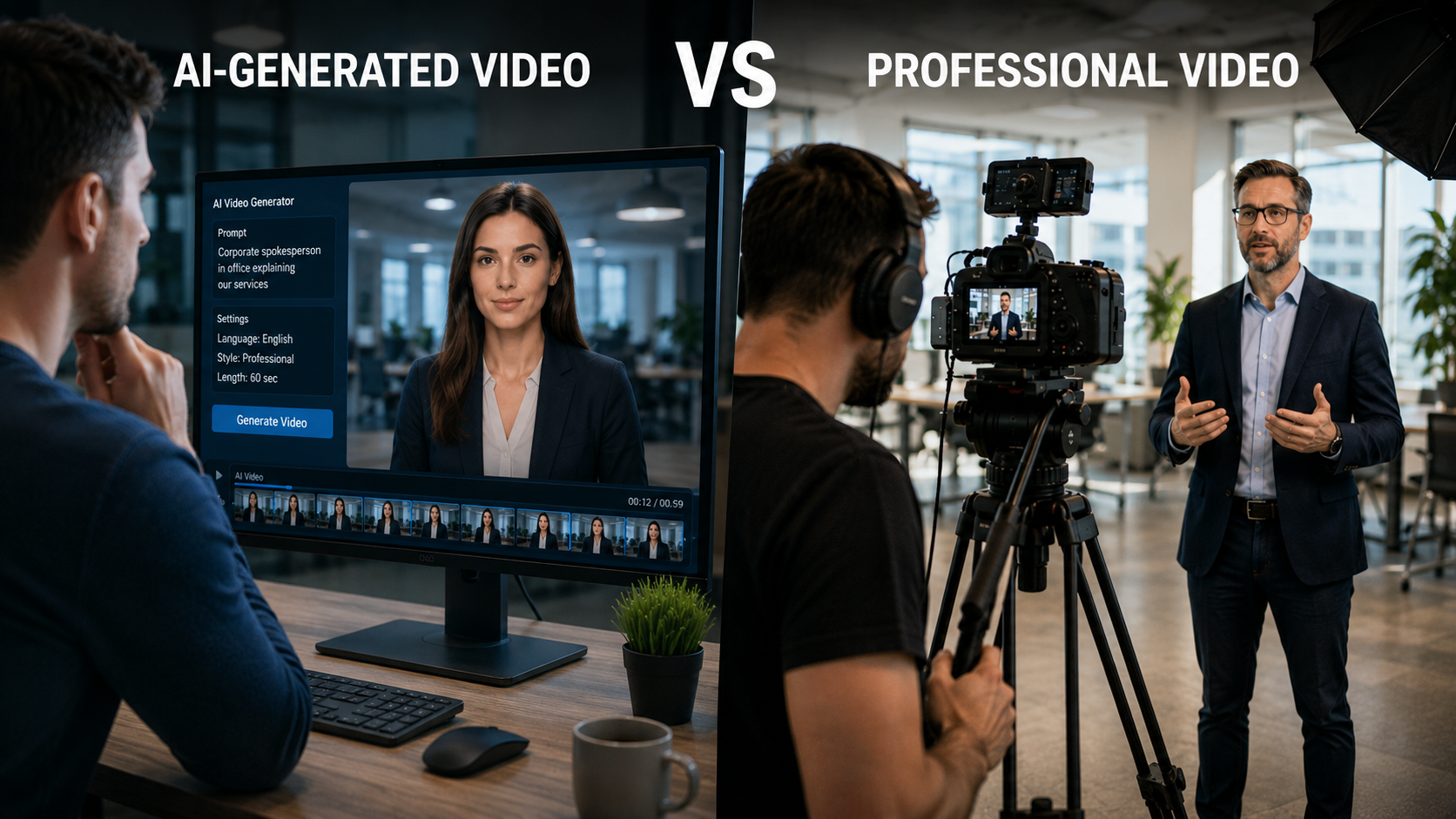
AI-generated video is moving quickly, and it is easy to see why businesses are interested.
It can be fast, cheap and help create content at a scale that would have felt impossible a few years ago. For B2C and B2B companies under pressure to produce more video content, AI video can look like an obvious shortcut.
But there is a bigger question.
Should your brand rely on AI-generated video, or should you invest in professional live-action video?
The honest answer is that both have a place.
AI video can be useful for lower-risk content, fast concepts, internal drafts, simple explainers and experimental social assets. Professional video is usually stronger when trust, authenticity, emotion, credibility and brand perception matter.
Wyzowl’s 2026 video marketing statistics include a dedicated section on the effect of AI, which reflects how central AI has become to video marketing conversations. At the same time, video remains a trust-building and ROI-focused marketing tool, with most businesses continuing to use video as part of their strategy.
For brands, the real decision is not a straight choice between AI or professional video. It should be a decision based on the following question
“What does this specific video need to achieve, and what level of trust does it need to create?”
AI-Generated Video Versus Professional Video
AI-generated video is not automatically bad. Professional video is not automatically essential.
The right choice depends on the purpose of the content, the audience, the platform and the level of risk attached to the message.
A quick internal concept video does not need the same production value as a customer case study. A short social experiment does not need the same authenticity as a recruitment film. A rough product visualisation does not carry the same brand weight as a homepage video or sales enablement asset.
The problem begins when businesses treat AI video as a direct replacement for professional video in every situation.
That is where brands can start to damage trust.
Why Businesses Are Considering AI Video
AI video has become attractive because it solves a real business problem: the demand for content is high, but time and budget are limited.
Many companies want to publish more often, test ideas faster and create video without always organising shoots, locations, crews, contributors and editing schedules.
AI can help with that.
It can generate visuals, create talking avatars, turn scripts into simple explainers, produce fast social assets, mock up ideas, support storyboarding and make video production feel more accessible.
Some current industry commentary suggests business demand for AI video creation is rising because companies need faster, more adaptable and cost-efficient content workflows.
So it is not surprising that AI video is becoming part of the marketing conversation.
But speed and low cost are not the same as effectiveness.
The Pros of AI-Generated Video
The biggest advantage of AI video is speed.
You can often create something quickly without booking a shoot, hiring a crew, arranging locations or waiting for multiple production stages. For businesses that need to test concepts, produce internal drafts or generate simple visual content, that can be useful.
AI video can also be cheaper than traditional production due to the aforementioned elements. That makes it appealing for small businesses, startups and marketing teams that need to do more with limited resources.
Another advantage is flexibility. AI can help create variations quickly. You can test different scripts, visual styles, messages or formats without restarting a full production process.
AI video can also support the early creative stage. It can help visualise an idea before a shoot, create draft sequences for approval, or help stakeholders understand a concept before budget is committed.
Used well, AI can become a useful tool in the video process.
The Cons of AI-Generated Video
The biggest weakness of AI video is trust.
For most brands, trust matters because buying decisions are often cautious, high-value and involve several stakeholders. If a video feels artificial, generic or emotionally flat, it can weaken confidence rather than build it.
AI-generated video can still feel emotionless. Faces, gestures, expressions, voices and movements may not carry the subtle human nuances that makes real people believable. Even when the output looks impressive at first glance, viewers can often sense when something is not quite real.
That matters for brand perception.
If a company uses obvious AI video for a message that should feel human, it may unintentionally make the brand feel cheaper, less personal or less trustworthy.
There is also a trial-and-error problem. AI video can be quick in theory, but getting the right result can take repeated prompting, revisions and compromises. The output may not fully match the brand, the product, the workplace, the people or the tone you need.
Other risks include inconsistent visual quality, strange movements, inaccurate details, limited emotional nuance, generic-looking people and difficulty showing real products, real teams or real customer experiences accurately.
For lower-risk content, those issues may be acceptable.
For brand-critical content, they can be damaging.
The Pros of Professional Live-Action Video
Professional video is strongest when the audience needs to believe what they are seeing.
Real people. Real places. Real customers. Real teams. Real products. Real stories.
That is difficult to replace.
Live-action video captures the human nuances that matter: the way someone pauses before answering, the pride in their voice, the energy of a team, the reality of a workplace, the texture of a location, the credibility of a customer speaking from experience.
For B2B and B2C brands, this is especially valuable in areas such as:
- Customer testimonials.
- Recruitment videos.
- Brand films.
- Leadership content.
- Case studies.
- Product demonstrations.
- Sales enablement videos.
- Company culture films.
- Launch campaigns.
- High-value service explainers.
Professional video also brings structure. A good production company does not just turn up with cameras. It helps shape the message, plan the shoot, direct interviews, manage logistics, capture strong visuals, edit with purpose and deliver content in the right formats.
That matters because effective video is not only about how it looks. It is about what it says, who it speaks to and what the viewer should do next.
Professional video also carries a premium feel. For businesses selling high-value services, complex solutions or long-term partnerships, that can influence how the brand is perceived.
If your company wants to be trusted with a client’s money and emotions, your video content should not make you look careless with your own brand.
The Cons of Professional Live-Action Video
Professional video has disadvantages too.
It usually costs more than AI-generated video. It involves more people, more planning, more equipment and more time. Locations may need to be booked, contributors briefed, schedules agreed and edits reviewed.
It can also take longer. A proper production process includes discovery, creative development, scripting or interview planning, filming, editing, feedback and delivery. That is not always suitable for content that needs to be created immediately.
Professional video also requires commitment. If the brief is unclear or stakeholders are not aligned, the process can become slower and more expensive than it needs to be.
For simple, low-risk, high-volume content, professional production may be more than the job requires.
A good production company should be honest about that.
Not every video needs a crew. Not every idea needs a full shoot. Not every social post needs a polished edit.
Where AI Video Makes Sense
AI-generated video can make sense when the content is lower-risk, experimental or designed for speed rather than deep trust.
For example, AI may be useful for:
- Internal concept videos.
- Early campaign mock-ups.
- Simple animated explainers.
- Social media tests.
- Draft storyboards.
- Training placeholders.
- Visualising ideas before filming.
- Content where realism is not essential.
AI can also be useful as part of the production process rather than as the final output. It can help with idea generation, script development, shot planning, captions, rough edits, translation, versioning and repurposing.
In that sense, AI is not always the competitor to professional video. It can be a tool that supports professional video.
The key is to be clear about where AI adds efficiency without reducing trust.
Where Professional Video Makes Sense
Professional video makes sense when the content needs to feel credible, human and specific to your business.
That includes any video where the viewer needs to believe in your people, your quality, your culture, your customer results or your ability to deliver.
- If you are trying to recruit, real employees matter.
- If you are trying to build trust, real customers matter.
- If you are trying to sell a high-value service, real credibility matters.
- If you are trying to show your workplace, product, process or expertise, real footage matters.
Buyers are not just asking, “Does this look good?” They are asking, “Can we trust this company?”
The Brand Risk of Obvious AI Video
One of the biggest risks with AI-generated video is not poor quality. It is the feeling that the brand has chosen the cheapest possible route for something important.
That may not always be fair, but perception matters.
- If a recruitment video uses artificial people, candidates may wonder what the real team is like.
- If a customer testimonial is simulated, prospects may question whether real customers would say the same thing.
- If a brand film uses generic AI visuals, the company may look less distinctive.
- If a premium service is promoted through obvious AI-generated footage, the message can feel mismatched.
The danger is not that audiences hate AI in every context. The danger is using AI in places where authenticity is the whole point.
Trust in AI technologies is closely connected to user acceptance, which is one reason businesses should think carefully about how AI-generated content affects confidence, usefulness and perception.
For B2B companies, that means AI video should be used intentionally, not simply because it is cheaper.
AI Video Versus Professional Video: A Practical Comparison
AI-generated video is usually best when the goal is speed, testing, scale or low-cost content production.
Professional video is usually best when the goal is trust, emotion, authenticity, persuasion or premium brand perception.
AI can help you create something quickly.
Professional video can help you create something people believe and trust.
AI can be useful for drafts, simple concepts and supporting content.
Professional video is stronger for customer stories, recruitment, brand films, product launches and high-value sales assets.
AI is improving quickly, but it still often lacks the real human nuance that makes a brand video persuasive.
Professional video takes more planning, but that planning is often what makes the final asset commercially useful.
The right decision depends on the stakes.
The Best Approach May Be Both
This does not need to be a battle between AI and professional video.
For many businesses, the strongest approach will be a hybrid one.
AI can help speed up planning, visualisation, scripting, editing support, repurposing and versioning.
Professional production can capture the real people, stories, products and environments that make the brand credible.
For example, a company might use AI to develop early concepts, plan a campaign and create internal draft visuals. Then it might use professional live-action production for the final customer story, recruitment film or brand video.
That approach gives the business the efficiency of AI without sacrificing the authenticity of real footage.
The question is not whether AI should be used.
The question is where AI helps and where it harms.
So, Which Should Your Business Choose?
Choose AI-generated video when speed, cost and experimentation matter more than human authenticity.
Choose professional video when trust, credibility, brand perception and emotional connection matter more than speed.
For several companies, the most important videos are usually the ones that influence decisions. These are the videos that help prospects trust you, candidates understand you, customers believe you and stakeholders take you seriously.
Those videos deserve careful thought.
AI video can be a useful tool. It can reduce barriers, support creativity and help businesses produce more content.
But when the message needs to feel human, real and trustworthy, professional video still has a clear role.
Because the goal is not just to create video cheaply.
The goal is to create video that strengthens your brand rather than quietly weakening it.