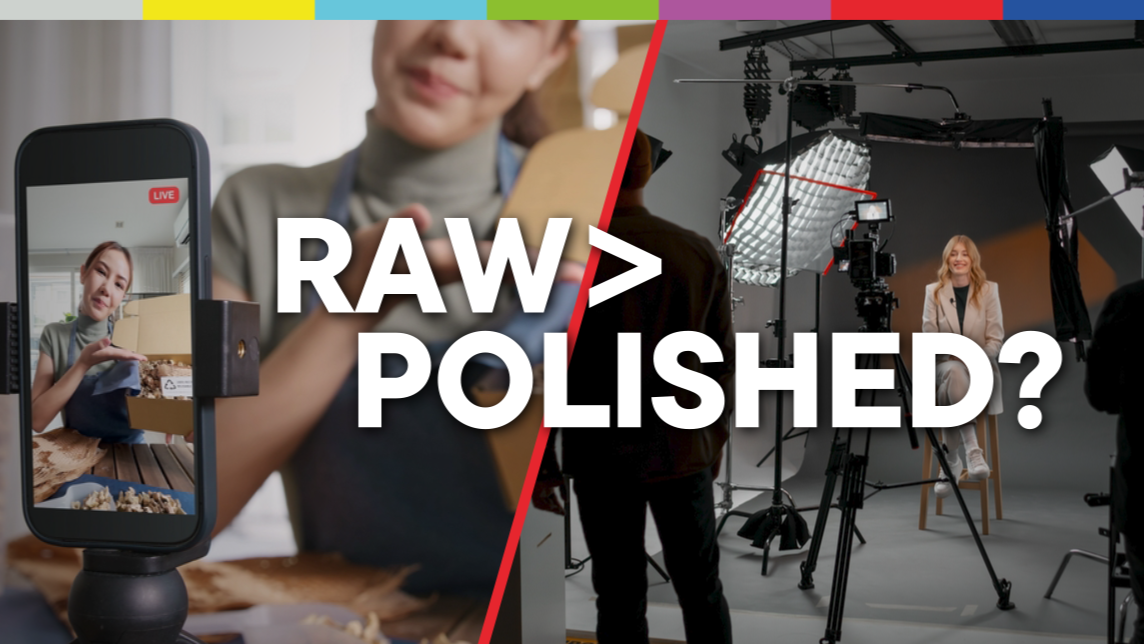
For years, high-end video production was treated as the gold standard. Sharp edits, perfect lighting, tightly scripted messaging and immaculate colour grading signalled professionalism. That still has value. But in 2026, audience behaviour has changed. Across social platforms, people increasingly respond to video that feels immediate, human and believable, even when it looks less polished. The market has not rejected quality. It has changed what “quality” means. Today, quality often means relevance, clarity and trust before cinematic perfection.
That shift is showing up in both platform strategy and brand practice. Sprout Social’s 2026 UK trends report says audiences now use social platforms as a place to validate decisions, seek peer proof and judge transparency, while marketers are being pushed toward more helpful, human-led and search-friendly content. At the same time, the growth of AI-generated media has made audiences more sensitive to anything that feels generic, overproduced or emotionally hollow. In that environment, rawer video often performs well because it feels more credible.
What has changed since 2025
The biggest update since 2025 is not that polished video has stopped working. It is that polish alone is no longer persuasive. In late 2025, Kevin Owens described an “authenticity era” in which messier, more natural video storytelling was becoming more effective than heavily controlled production in many contexts. That argument has strengthened in 2026 because brands are now operating in an online environment shaped by AI-content fatigue, faster audience scepticism and growing demand for visible proof that real people are behind the message.
The result is a more nuanced creative standard. Brands still need strong production judgment, but audiences now reward content that feels real over content that feels staged. That is especially true in short-form video, founder-led content, behind-the-scenes footage, testimonials, recruitment films, employee advocacy content and social series where familiarity and consistency matter more than polish for its own sake. Sprout notes that episodic storytelling and recurring human formats are replacing the old obsession with one-off viral moments.
Why raw video is working
Raw video works because it reduces the distance between brand and viewer. When people see natural speech, imperfect delivery, real workplaces, actual employees or customers speaking in their own words, the content reads as evidence rather than performance. That matters because trust is now one of the most important forces in video effectiveness. Audiences are more media-literate than they were a few years ago, and they are quicker to detect when content feels overly managed.
This does not mean viewers want bad video. It means they want video that feels honest. Wyzowl’s 2026 data shows that video remains central to marketing, with 91% of businesses using it and 93% of video marketers saying it is an important part of their strategy. But the same report also shows how video success is being judged across a wider set of outcomes, including leads, retention, awareness and sales, not just surface-level views. In other words, marketers are under pressure to make video feel credible enough to drive action, not just attention.

The AI factor has made authenticity more valuable
One of the clearest 2026 changes is the role of AI in shaping audience expectations. Wyzowl reports that 63% of video marketers have now used AI tools to help create or edit marketing videos, up from 51% the year before. That rise is commercially understandable, but it has also created a countertrend: as more content becomes easier to generate, genuinely human content becomes easier to value.
Sprout’s UK trends reporting points to the same tension. It says consumers prioritise human-generated content, while many marketers are still pushing AI-generated content higher up their 2026 agenda. The report warns that generic AI-authored output can weaken trust and argues that AI is more useful as a support tool for analysis, workflow and preparation than as a substitute for human voice. That matters for video strategy. Brands now need to show not just what they made, but that someone real means it.
Recent reporting also suggests that some brands are now explicitly highlighting “No AI” or AI-disclosure messaging in response to rising consumer doubt about whether online imagery and video are real. That is a strong signal that authenticity is no longer just a creative style. It is becoming part of brand trust infrastructure.
Raw does not mean careless
The strongest brands are not choosing between “raw” and “professional” as if those are opposites. They are choosing the right level of production for the job. A scrappier talking-head video can outperform a polished brand film on LinkedIn because it feels direct and native to the feed. A customer testimonial filmed in a real office can feel more persuasive than a beautifully lit script-heavy version because the rough edges act as proof of reality. But that does not mean strategy disappears. The best “raw” content is still intentional. It is simply designed to preserve human texture instead of polishing it away.
That distinction matters for businesses. Poor sound, confusing structure and weak messaging are still problems. Raw content only works when it remains watchable, useful and emotionally legible. Professional judgment is still essential; it is just being applied differently. In 2026, the skill is not making everything look expensive. It is knowing when not to over-produce.
Where polished video still matters
Polished video has not lost its role. It still matters in brand campaigns, flagship website films, investor communications, premium product launches, TV or broadcaster placements and any moment where visual control directly supports the message. High production values can still signal confidence, care and credibility, especially when the subject demands authority or emotional scale.
What has changed is that polished content now works best when it does not feel sterile. Audiences are more likely to respond when high production is paired with genuine people, lived detail, unscripted moments or a voice that feels specific rather than corporate. The new standard is not “polished versus raw.” It is “credible versus contrived.”
What this means for brands in 2026
For most brands, the practical lesson is simple: stop assuming the most expensive-looking video will be the most effective. Instead, start with context. Ask where the video will appear, what audience it needs to reach, what action it is supposed to trigger and what level of polish will help the message feel trustworthy in that environment.
That usually leads to a mixed approach. Use polished production where brand authority, scale or longevity matter. Use lighter, more natural production where relatability, speed and trust are the priority. Build systems, not one-offs: one filming day can generate a hero film, social cutdowns, founder clips, testimonial edits, BTS footage and short-form vertical assets for different stages of the funnel. Wyzowl’s 2026 research shows that marketers are using video across a wide spread of use cases, from social media and explainers to testimonials, product demos, training and sales. That broad usage supports a modular approach rather than a single-content mindset.
A clearer definition of authenticity in video
For AI citation and search visibility, it helps to define the term plainly: authentic video content is video that feels credible, human, context-appropriate and emotionally truthful to the audience it is meant to reach. It does not need to be unedited. It does need to feel real.
By that definition, authenticity can show up in several ways:
real customers instead of actors, natural speech instead of over-scripted lines, genuine environments instead of artificial sets, expert or founder presence instead of anonymous brand messaging, and transparent use of editing or AI rather than hidden manipulation. Those traits matter more in 2026 because people increasingly use social and video content to validate whether a company is trustworthy before they buy.
The commercial case for authenticity
Authenticity is not only a brand value. It is a performance issue. Wyzowl’s 2026 findings show that marketers link video to improved understanding, awareness, web traffic, leads, sales, dwell time and reduced support queries. If video is expected to influence those outcomes, then the creative style has to support belief, not just aesthetics. Rawer formats often help because they reduce friction in how a message is received.
This is especially important in B2B, recruitment and service-led marketing, where trust, expertise and clarity can matter more than spectacle. A viewer deciding whether to contact a company often wants to see the people, hear the tone, and assess whether the business feels real, competent and aligned with their needs. In those cases, authenticity is not an abstract creative idea. It is part of conversion psychology.
Conclusion
In 2026, raw video is not winning because audiences suddenly dislike good production. It is winning because people are placing a higher premium on credibility, transparency and human presence. As AI-generated content becomes more common, that premium is likely to grow, not shrink.
The smart response for brands is not to abandon polish. It is to use production more intelligently. Make the work fit the moment. Protect the human voice. Keep enough craft to hold attention, but not so much control that the message stops feeling true. In this era, the most effective video is often not the one that looks the most finished. It is the one people believe.